CASE STUDY
Empowering people with greater financial literacy
CASE STUDY
Empowering people with greater financial literacy
As part of a Dow Jones initiative, the goal was to simplify financial topics by breaking down complex concepts into clear, bite-sized content. This made the insights easier to read, understand, and apply to everyday life.

For many people, anything related to finance and investing seems complex and unclear.
OVERVIEW
For many people, anything related to finance and investing seems complex and unclear.
Most people avoid learning about personal finance because it feels overwhelming, unless it's made simple, relatable, and easy to follow. New investors don't want to feel like they need a finance degree just to get started. They look for information that meets them where they are.
The solution was a content experience built around clarity and pace — using plain language, clear hierarchy, and bite-sized formats to help users absorb information without feeling rushed or overwhelmed. Every design decision, from layout to tone, was made to build trust and confidence at each step of the journey.
PROCESS
Stage 1: Logo & Brand Identity
The first step was establishing a foundational logo and visual identity for Dow Jones Smart Money. The goal was to create a mark that felt credible and trustworthy. Reflecting The Dow Jones authority in finance was key, but should also feel warm and helpful. Early exploration centered on the user, designing a brand that felt trusted and upbeat without overwhelming readers just starting their financial journey.
Stage 1:
Logo & Brand Identity
The first step was establishing a foundational logo and visual identity for Dow Jones Smart Money. The goal was to create a mark that felt credible and trustworthy. Reflecting Dow Jones's authority in finance was key, but should also feel warm and helpful. Early exploration centered on the user, designing a brand that felt trusted and upbeat without overwhelming readers just starting their financial journey.



Stage 3: UI and Interface
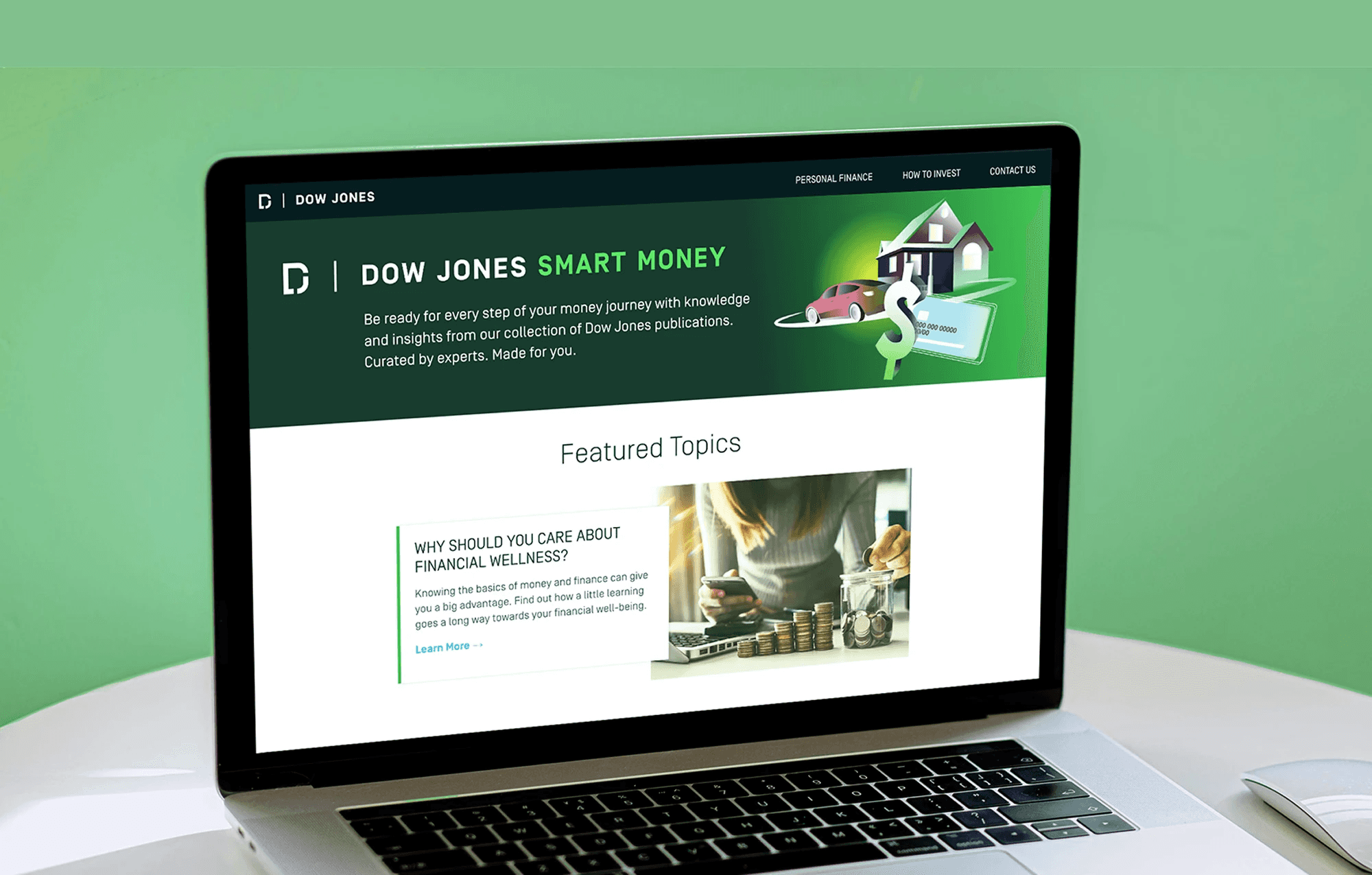
With the brand system in place, I led the design of early-stage content pages in Figma, turning dense financial topics into something people could follow. We broke longer topics into bite-sized sections, added visual cues like icons and callouts, and let readers move through material at their own pace; no finance degree required. Templates were built to flex and scale, so the editorial team could keep creating content without ever losing that sense of the user.
Stage 2: Brand Identity System
Once the logo was finalized, the identity was scaled into a full brand design system — documenting the color palette, typography, iconography, layout guidelines, components, and patterns. The system was built to scale across a wide range of touchpoints and use cases, with accessibility guiding every decision. We paid close attention to color contrast and typography to ensure readability across all devices.
Stage 2:
Brand Identity System
Once the logo was finalized, the identity was scaled into a full brand design system — documenting the color palette, typography, iconography, layout guidelines, components, and patterns. The system was built to scale across a wide range of touchpoints and use cases, with accessibility guiding every decision. We paid close attention to color contrast and typography to ensure readability across all devices.
Stage 3: UI and Interface
With the brand system in place, I led the design of early-stage content pages in Figma, turning dense financial topics into something people could follow. We broke longer topics into bite-sized sections, added visual cues like icons and callouts, and let readers move through material at their own pace; no finance degree required. Templates were built to flex and scale, so the editorial team could keep creating content without ever losing that sense of the user.
Stage 4: Development Collaboration & Launch
Throughout the build phase, I partnered closely with the development team through regular check-ins to ensure design fidelity from Figma to production. This collaborative process was critical to catching responsive and interaction issues early, align on edge cases, and maintain the integrity of the brand system. The result was a smooth, well-coordinated launch that stayed true to the vision. Marketing assets, including emails, banner ads, and social content, were developed to support the launch.

REFLECTION
A lack of financial knowledge can make it hard to manage income and expenses effectively, and to make informed financial choices. This raised an important question: how might we make it easier for people to learn how to manage their finances and work toward financial independence?
Dow Jones Smart Money was designed to answer that question — meeting people at every stage of their financial journey, whether they're living paycheck to paycheck, working through high-interest debt, or learning how to save and invest for the future. Complex topics like credit, retirement planning, and smart investing are translated into clear, actionable content that doesn't require a finance background to understand.
By addressing real, everyday financial challenges (not just theory) Smart Money helps people build the confidence and knowledge to make better financial decisions.


Role: Creative Lead
Industry: Financial Literacy
Duration: 2 months
Role
Creative Lead
Industry
Financial Literacy
Duration
2 months
Interested in connecting?
Interested in connecting?
Interested in connecting?
© 2026 Tina Simpkins. Think deeply. Design clearly.
© 2026 Tina Simpkins. Think deeply. Design clearly.
© 2026 Tina Simpkins. Think deeply. Design clearly.